
Only a few hours after my husband’s military funeral, my own family looked at my pregnant stomach and decided I should sleep in the freezing garage so my sister’s wealthy husband could take over my bedroom. My father complained that my tears were destroying Thanksgiving, and everyone seemed to be waiting for me to finally fall apart.
Instead, I smiled and quietly replied, “Okay,” because none of them knew about the military extraction orders already issued for me—or who I truly was. At exactly 5:02 a.m. on Thanksgiving morning, my phone vibrated against the kitchen counter.
It was my older sister, Harper. “There you are,” she said without bothering to say hello. “Mom and Dad decided Julian needs your room. Pack your things. You can sleep in the garage.”
I stared into my coffee. Frost silvered the windows, and the house was cold enough that I could see my breath. I was five months pregnant with David’s baby, wearing one of his old Army T-shirts because it was the only thing in the bedroom that still smelled like him.
“The garage?” I asked. “It’s below freezing.” My mother kept stirring cream into her coffee as though we were discussing folding chairs. My father lowered his newspaper and gave me the same irritated look he had worn during David’s funeral hours earlier.
“You heard your sister,” he snapped. “Stop acting like the whole world owes you sympathy. Your crying is already ruining Thanksgiving.” The Army had notified us of David’s death seven months earlier, after a classified mission overseas. The funeral had been delayed, but my family’s patience with my grief had apparently expired long before the service.
David had bought this house with years of military pay and sacrifice. He had made every mortgage payment, replaced the cabinets, patched the drywall, and rebuilt the kitchen between deployments while talking about the family we would raise there. Now my parents treated his home like abandoned property.
Harper entered wearing a silk robe, followed by Julian, who carried gourmet coffee and spun the keys to his Audi around one finger. “It’s only temporary,” Harper said. “Julian needs a private office for his investment business.” Then she looked at my stomach. “Besides, your grieving is becoming exhausting.”
My mother finally faced me. “Put your boxes neatly in the garage. Don’t block the middle. Julian parks his Audi there.” Julian laughed and thanked her. None of them noticed how tightly my wedding ring pressed against my swollen finger. No one looked twice at the military bracelet around my wrist. They saw a pregnant widow in an old T-shirt—too tired to fight and too dependent to leave.
That was the version of me they believed they knew. For almost twelve years, David and I had both served as senior officers in the United States Army. Our assignments required secrecy. We never discussed our ranks, missions, or locations, and we never wore our dress uniforms around family.
To them, David was a government consultant. To them, I handled administrative paperwork for the Department of Defense. That cover story had protected people whose names my family would never hear. That morning, it was also protecting the people ordering me into a freezing garage.
They thought David had left nothing but an insurance policy. They did not know his final mission remained classified. They did not know I was still on active duty. And they certainly did not know that less than twelve hours earlier, encrypted orders had officially ended my emergency leave.
An extraction team was already coming for me. I looked around the kitchen—my father hiding behind his newspaper, my mother beside the sugar bowl, Harper waiting for me to argue, and Julian spinning those car keys with complete confidence.
There was no compassion on their faces. Only impatience and the certainty that grief had made me powerless. So I smiled. Quiet. Controlled. “Okay,” I said. “I’ll move.”
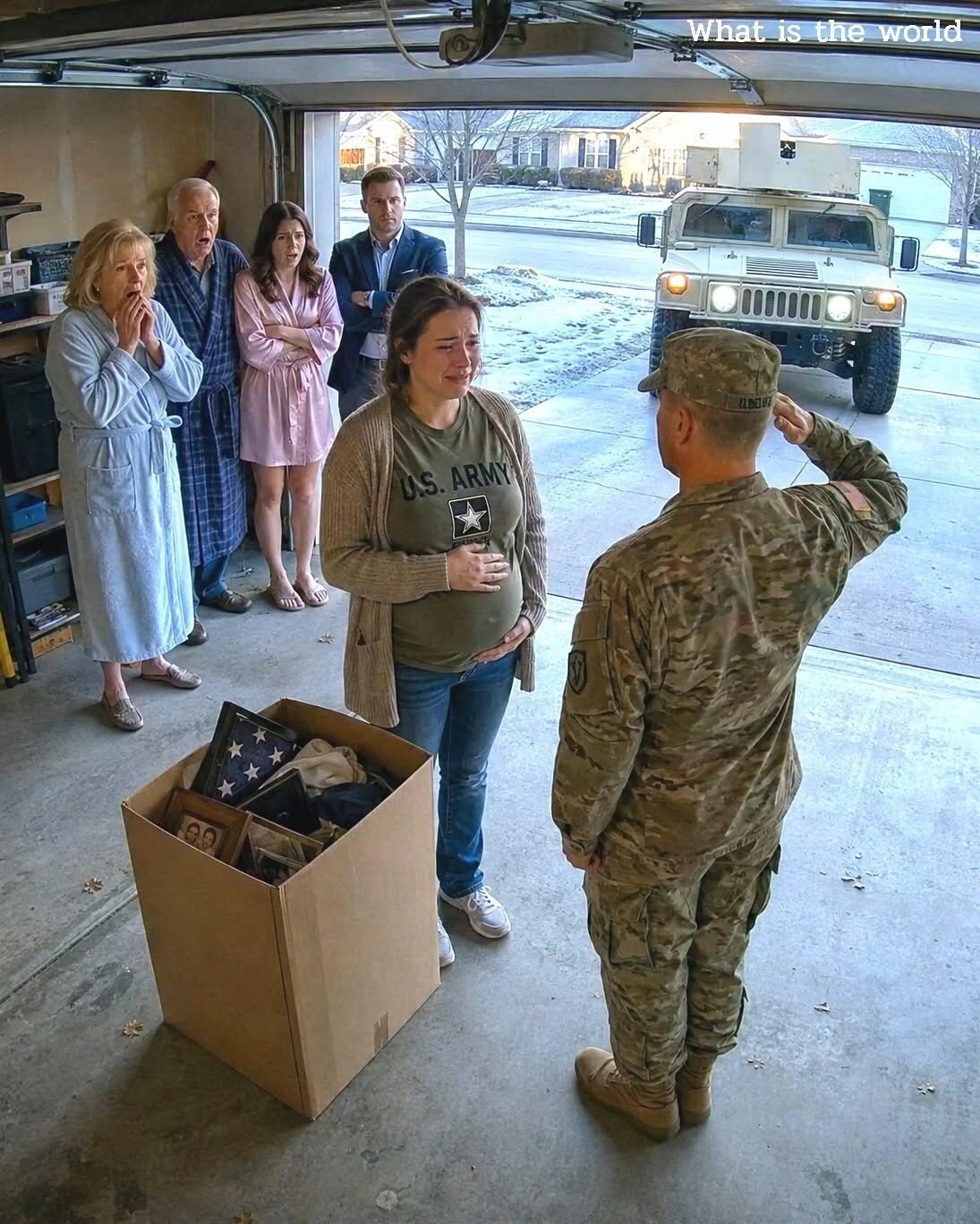
Relief crossed their faces. Harper looked pleased. My father raised his newspaper again. Julian headed toward the driveway as though the house already belonged to him. I carried one cardboard box into the garage and set it beside the door. Cold concrete burned through my socks, and the baby shifted sharply beneath my ribs.
Then an engine growled down the silent street. Julian stopped with one hand on the Audi. A second engine followed. Then another. Dark military vehicles passed the mailbox and entered the driveway in a tight formation, their tires grinding over the frost. My mother moved toward the front door. Harper appeared behind her. My father’s newspaper slowly folded against his chest.
The first vehicle stopped. A uniformed soldier stepped out and walked directly toward me, passing Julian without acknowledging him. At the garage entrance, he straightened his shoulders and raised a sharp, precise salute.
(The true identity of the pregnant widow is about to be revealed! Click “Next Page” to continue reading…)
