
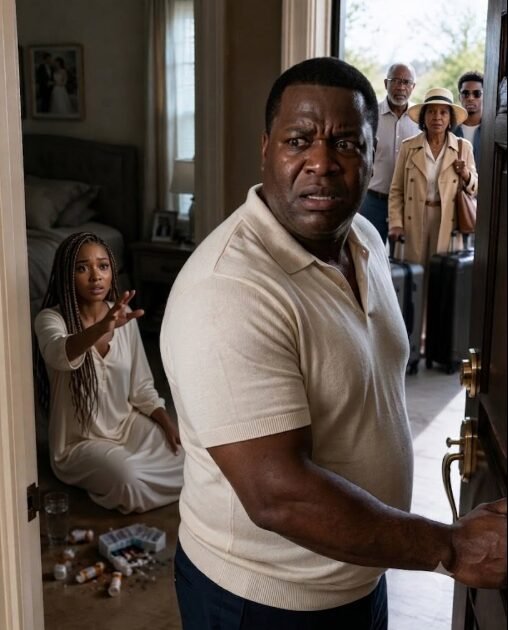
The cold metal of the emergency maintenance panel bit into my fingers as the line went dead. I slumped against the drywall inside the tight space, listening to the heavy silence of the unventilated hallway. Without air conditioning, the muggy July heat had already begun to saturate the upper floor, turning the air thick and stifling. My body was trembling, a violent reaction from both the physical exertion of crawling across the master bedroom and the terrifying reality of my missing medication. My kidneys were pulsing with a deep, dull ache, warning me that every passing minute without my daily treatment was pushing my organ function closer to total collapse.
I pulled myself into a sitting position, resting my back against the inner studs of the wall framing. Daniel and his mother had operated under a dangerous assumption born of pure arrogance. To them, my recent diagnosis had transformed me into an invalid—a fragile, helpless creature who existed solely at the mercy of her caregivers. They believed that by shutting off the main electrical breaker, severing the municipal water line, and confiscating my smartphone, they had rendered the house an inescapable, lightless vault.
They had entirely forgotten the four years I spent working as a senior systems engineer for high-end residential estates before my body began to fail me. When Daniel and I bought this property, I didn’t just redecorate; I completely overhauled the structural grid. Hidden behind the drywall in three key locations throughout the floor plan were isolated, solar-fed lithium sub-batteries wired directly into secondary water reserves, emergency lighting, and an encrypted hardwired communications loop. Daniel had treated my obsessive blueprints as an expensive hobby, never bothering to learn how the hidden architecture of his own home actually functioned.
Less than eighteen minutes after I sent the triple-pulse alert to my uncle Robert, the heavy silence of the cul-de-sac was broken by the muffled thud of high-performance tires pulling onto the driveway. There were no flashing lights or wailing sirens—Robert knew better than to create a spectacle before securing the perimeter. Through the narrow ventilation slats of the maintenance hatch, I heard the sharp, metallic crunch of a hydraulic pry-bar taking hold of the front deadbolt. Within seconds, the reinforced oak door swung open, allowing a rush of fresh, cool evening air to flood into the darkened foyer.
Heavy footsteps echoed across the hardwood floors, accompanied by the urgent, quiet commands of emergency responders. First through the threshold was Dr. Vance, my primary nephrologist, carrying a specialized medical bag containing high-dose intravenous immunosuppressants. Right behind him was Uncle Robert, his sharp gray eyes sweeping the darkened hallway with the terrifying intensity of a man who had spent thirty years as a federal prosecutor. Behind them stood two uniformed state troopers, their flashlights cutting long, sharp beams through the ambient dust floating in the stagnant air.
“Claire!” Robert’s voice boomed through the lower level, filled with a mixture of raw anxiety and suppressed fury. “Claire, where are you?”
“Upstairs… behind the linen closet,” I called out, my voice raspy and thin, barely carrying over the hum of the portable medical equipment Dr. Vance was dragging behind him.
The responders moved up the staircase with practiced efficiency. When Dr. Vance spotted me sitting in the narrow maintenance opening, he immediately dropped to his knees, taking my blood pressure and checking the color of my fingernails. Within two minutes, an IV line was successfully established in my left arm, pumping the vital, life-saving fluids directly into my bloodstream. As the medication began to ease the brutal pressure in my lower back, Uncle Robert knelt beside the doctor, his face rigid as he took in the full scene.
He looked at the empty glass on the nightstand, the severed water valves, and the dark electrical panel downstairs. He watched as the state troopers systematically photographed every room, documenting the turned-off breakers, the locked windows, and the complete absence of my daily medical supplies. Every single detail was being recorded, timestamped, and cataloged into a formal evidentiary chain of custody.
“This is not simple domestic abandonment, Claire,” Robert said, his voice dropping to a low, icy whisper that chilled me far more than the air conditioning ever could. “He took your phone, cut off your life support systems, and locked the primary egress. In the eyes of the court, this is a calculated attempt to cause severe bodily harm or death for personal gain.”
He opened his leather briefcase, pulling out a freshly printed document bearing the official seal of the County Assessor’s Office. He held it out so I could see the signatures at the bottom of the page.
“Two days ago, Daniel filed a motion for temporary emergency guardianship,” Robert explained, pointing to the fraudulent signature on the second page. “He was setting the stage to assume complete control over your pre-marital trust fund, claiming you were mentally incapacitated by your autoimmune condition. If you had died in this house over the next eleven weeks, he would have inherited your entire estate without a single question from the probate court.”
I stared at my husband’s handwriting on the legal paper, feeling the final lingering fragments of my grief transform into something cold, hard, and unyielding. The man I had loved for six years hadn’t just abandoned me to enjoy a European vacation; he had designed a slow, silent execution so he could claim my life’s savings without getting his hands dirty.
“We can file an international warrant tonight,” the lead state trooper offered, stepping into the doorway with his notebook in hand. “Interpol can detain Daniel and his mother the moment their flight touches down in Paris.”
I looked at the IV bag slowly dripping into my vein, then at my uncle, whose eyes reflected the exact same ruthless strategy forming in my own mind.
“No,” I said quietly, the weakness leaving my voice as a dark, absolute clarity took its place. “If you arrest him in Paris, his lawyers will claim it was a tragic misunderstanding. They will say he panicked, or that his mother misled him. I want him to spend every single day of his seventy-four-day vacation believing his plan worked.”
Robert slowly nodded his head, a cold, grim smile touching the corners of his mouth as he understood my intent.
“Let them spend their money,” I continued, looking around the room that was no longer my prison. “Let them enjoy the luxury hotels, the Mediterranean cruises, and the expensive dinners. We are going to use the next ten weeks to systematically strip Daniel and Patricia of every single asset, account, and legal right they think they own.”
Turn to the next page to see how Claire executed her quiet, high-stakes revenge over the next two months.
