
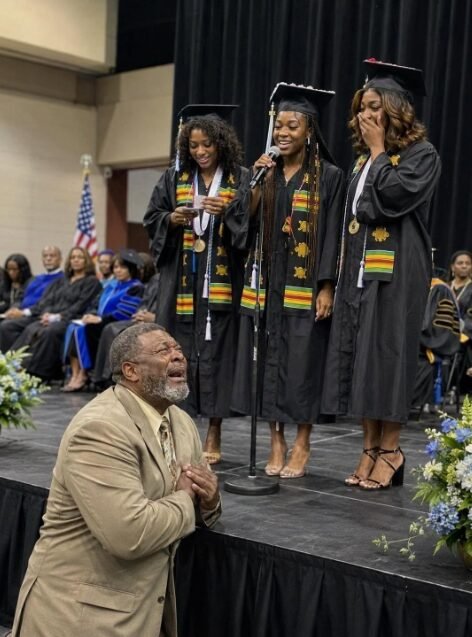
The hum of the arena’s air conditioning seemed to vanish, swallowed by a heavy, suffocating stillness that stretched across thousands of rows of seating. My fingers tightened around the worn grip of my cheap camera until the plastic groaned under the pressure. In the second row of the faculty section, the dean stepped back, giving the three young women the center of the oak stage.
For twenty-two years, the name of my brother, Julian, had been a phantom in our household. We didn’t speak it over cereal bowls or during late-night emergency room visits when croup threatened to close Nora’s airways. We had buried his memory under years of mortgage payments, secondhand textbooks, and the relentless march of daily survival.
Nora took a slow, measured breath, her knuckles white where she gripped the aluminum podium. Her voice, usually so restrained and precise, trembled slightly as it amplified through the arena speakers, bouncing off the rafters where championship banners hung in the dim light.
“Three months ago, while clearing out the old storage unit behind the hardware store on Elm Street, we found a rusted metal tackle box locked under a pile of rotted canvas,” Nora said, her eyes searching the vast sea of faces until they locked directly onto mine. “Inside was an envelope addressed to the three of us, stamped with a postmark from the week we turned eighteen.”
A soft, collective murmur rippled through the audience like wind rustling through dry corn husks. Beside me, an elderly woman in a floral dress leaned forward, adjusting her reading glasses to get a better view of the stage. My knee throbbed with a dull, familiar ache, but my body felt completely numb, anchored to the concrete floor by sheer shock.
I remembered that storage unit. I had paid eighty dollars a month for over two decades to keep our old life locked away—boxes of my late mother’s china, broken tools, and the baby cribs I couldn’t bear to sell. I thought I knew every inch of that dark, dusty space, but Julian had always been a master of hiding things where nobody thought to look.
On stage, Maya stepped forward, unfolding the yellowed sheet of paper with delicate, deliberate care. Tears were already spilling freely down her cheeks, catching the bright glare of the overhead stage lights. She didn’t look at the crowd; she kept her eyes fixed entirely on the faded blue ink written in her biological father’s erratic, hurried script.
“We always believed our father ran away because he was weak,” Maya read aloud, her voice wavering with emotion. “We believed he looked at three helpless infants and decided his own freedom was worth more than our lives. That is the story the town told us, and it is the story we grew up believing every time someone looked at us with pity.”
She paused, taking a ragged breath as Elise placed a steadying hand on her shoulder. The entire auditorium remained dead silent, waiting for the truth that had been hidden beneath two decades of silence.
“But the letter we found wasn’t an apology for leaving,” Maya continued, her voice gaining strength as the words echoed off the high ceiling. “It was an admission of what happened the night our mother vanished from our lives.”
Turn to the next page to discover the secret Julian left behind in the tackle box.
