
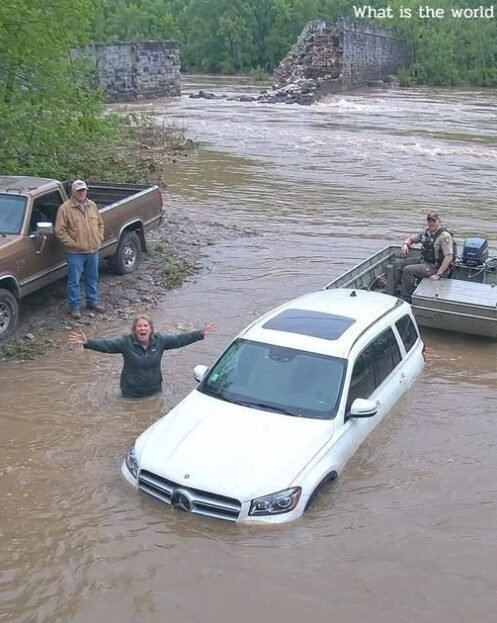
My family built the stone dam across the Branch River in 1793. I spent the last 28 years of my life as a state dam safety engineer making sure structures just like it didn’t fail.
Then an HOA president from Connecticut decided my dam was in her way.
Her name was Heather Lynn. She was the president of Cascade Meadows Estates, an 84-home subdivision built in a low-lying valley directly below my 180-acre property. She drove a white luxury SUV, wore pearls to the local hardware store, and firmly believed that living in a rural area meant reshaping it to look like a park.
It started with a piece of paper taped to my gate. It was an invoice for $400. The HOA had passed a new bylaw requiring anyone who “benefited from community water features” to pay an annual assessment.
I didn’t live in the HOA. My dam wasn’t a community feature. It was private property that my ancestors literally built by hand.
I returned the invoice. She sent it back with a threat. I ignored it. She took me to small claims court. The judge laughed her out of the room. That was when Heather went nuclear.
She and her husband retained an aggressive Burlington law firm. They petitioned the Vermont Environmental Court to forcefully demolish my dam, claiming it was an unpermitted nuisance that was hoarding public waters.
I pulled the state business filings. I quickly found out this wasn’t just about a stubborn HOA president. Heather’s husband had quietly registered an LLC eight months earlier. He had been filing inquiries with the regional planning commission about developing the dry riverbed land that would be exposed if my dam was ever removed.
They weren’t trying to free a river. They were trying to steal land to build more houses.
I called my daughter, Maren, who studies hydrology at the university. She came home, and we spent the weekend modeling the valley.
“Dad,” she said, tapping her laptop screen. “The dam holds back 11 million gallons. If it’s removed before the spring snowmelt, peak discharge moves downstream immediately.”
“It hits the subdivision,” I said.
“The whole thing,” she confirmed. “The bowl fills first. If there’s a heavy rain event on top of the snowmelt, they get five feet of water in their living rooms within 24 hours.”
I drafted a massive 283-page response filing. It included certified copies of every state permit my dam held, and a highly detailed hydrological model showing exactly how fast Cascade Meadows Estates would drown if the dam came down.
At the court hearing, Heather sat smugly with her high-priced lawyers. They paraded in an “expert” engineer who completely ignored the concept of peak discharge.
I took the stand. I gave the judge my credentials as the state’s former Chief Dam Safety Engineer.
“Your Honor,” I said clearly for the court record. “Removing this structure in the spring runoff season will cause a catastrophic flood of the 84 homes downstream. I have kept that valley dry for 28 years.”
The judge, leaning heavily into a misguided interpretation of environmental restoration laws, overruled my warning. She ordered me to demolish my own dam within 90 days.
Heather beamed. Her lawyers shook hands. They thought they had outsmarted the local rural guy.
I walked out of that courthouse into the cold March air. I looked at my daughter, handed her the 283-page hydrology report, and made my decision.
I wasn’t going to fight the court order anymore. I was going to tear my own dam down just in time for the spring snowmelt. And I was going to let the river teach HOA Karen the one lesson she refused to learn.
PART 2: FOLLOWING THE LETTER OF THE LAW
I hired a heavy excavation crew the very next morning, ensuring every permit for demolition was signed, sealed, and delivered strictly according to the court’s expedited timetable.
Heather pulled up to my property line in her white SUV three days later, holding a coffee cup and recording video on her phone with an air of triumphant satisfaction.
“I see you finally learned to respect authority,” she yelled over the roar of the diesel machinery tearing into the two-hundred-year-old stone masonry.
I didn’t answer her; I simply held up a copy of the court order, pointing to the judge’s mandate that demanded complete removal before the third week of April.
What Heather failed to understand was that late April coincided perfectly with the mountain range’s heaviest snowmelt and the annual spring deluge.
By day four, the central spillway was completely dismantled, and the full weight of eleven million gallons of backed-up river water began to surge freely downstream.
As the ancient stone barrier gave way, the Branch River reclaimed its natural, violent velocity, rushing straight toward the basin of Cascade Meadows Estates.
(The storm of the century is heading straight for the valley! Click “Next Page” to continue reading…)
