Part 4: Walking into the Light
The sudden knock at the dressing room door broke our quiet sacred space. My maid of honor called out through the heavy wood, her voice laced with nervous anticipation. “Elena? The organist is starting the processional. Everyone is seated. Are you two ready?”
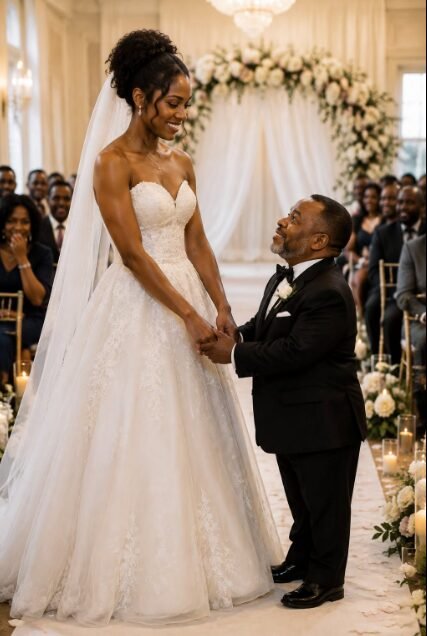
I stood up slowly, reaching down to pull Noah up onto his feet beside me. He smoothed down the front of his dark tuxedo jacket, wiping the wetness from his cheeks with the back of his sleeve, looking up at me with an intensity in his eyes that I had never seen before.
“Are you sure, Elena?” he asked one last time, his voice strong and clear now, completely free of the hesitation that had held him captive just moments earlier. “Once we walk through those doors, people will talk. They will always talk.”
“Let them talk,” I replied, taking his arm and weaving mine through it with absolute pride. “They’re watching from the outside of a world they aren’t built to understand. All that matters is what we build inside it.”
We walked out of the dressing room together, navigating the quiet stone hallway toward the massive wooden doors that led into the main sanctuary. Through the stained glass windows, sunlight poured down in vibrant streams of gold and blue, illuminating the path ahead of us.
When the heavy doors swung open, the entire assembly of guests stood up in unison. I saw my mother standing in the front row, her face pale, her hands tightly clutching her program as she watched us step onto the carpet together.
There were whispers, of course. There were widened eyes from distant relatives who hadn’t seen Noah in years, and subtle nods of confusion from old acquaintances who still viewed our relationship through the narrow lens of judgment. But as we walked down that long central aisle, step by synchronized step, the noise of their expectations faded into complete insignificance.
Noah walked with his head held high, his posture straight, holding my hand with a quiet, unshakeable strength that commanded the respect of every person in that room. He wasn’t hiding behind his condition anymore, nor was he bowing beneath the weight of other people’s cruel assumptions.
When we reached the altar, the officiant smiled down at us, asking the traditional questions that had bound couples together for generations. But when it came time to exchange our personal vows, Noah didn’t read from a card.
He looked directly into my eyes, reached into his jacket pocket, and pulled out a small, faded wooden ring that he had carved himself on the playground when we were children—a tiny token he had carried in his pocket for twenty-three years.
“Elena,” he said, his voice echoing clearly off the vaulted ceiling of the church, steady and resonant. “Twenty-three years ago, I gave you a promise because I couldn’t bear to see you cry. Today, I give you my life because you showed me how to live.”
I slid the band onto my finger, tears of joy streaming down my face as the entire congregation erupted into a sudden, unexpected wave of applause, drowning out every past insult, every cruel whisper, and every doubt that had ever tried to tear us apart.
We turned toward the crowd as husband and wife, hand in hand, stepping forward into a future built not on physical perfection, but on an unbroken promise that had survived the ultimate test of time.