
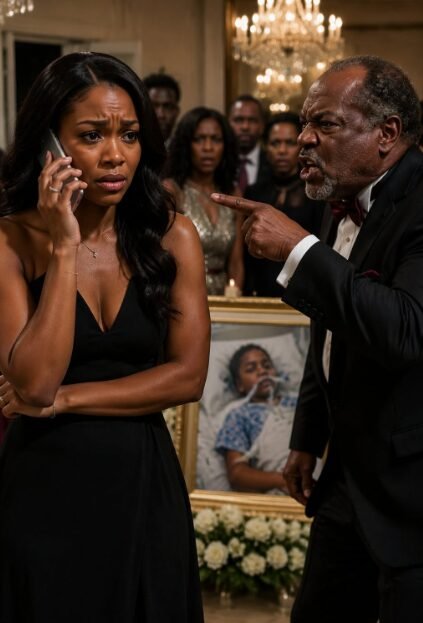
Three days before my oldest son’s wedding, my former mother-in-law called me with a warning. She wasn’t calling to congratulate Caleb, nor was she calling to ask about the ceremony. She was calling because she had decided it was finally time to tell “her truth.”
“You’ve stayed silent long enough,” Judith said. Her voice was calm—too calm—the kind of calm people use when they believe they are holding a lethal weapon. “Everyone deserves to know the choices you made as a mother.”
I was standing inside the florist’s shop holding a sample centerpiece for my son’s wedding. White roses surrounded a shallow glass bowl while thin green branches stretched upward in the exact shape Caleb’s fiancée had chosen. Around me, employees moved between buckets of flowers, trimming stems and preparing arrangements for the biggest day of my son’s life. Nobody noticed my hand shaking, and nobody knew that one phone call had dragged me back eleven years.
“What exactly are you planning to say?” I asked. “The truth,” she replied. I almost laughed, because coming from Judith, that word had always meant something entirely different. “Your truth,” I said.
“You arranged for your own child to live somewhere else because caring for him became too difficult.” The sentence hit harder than I expected. Not because it was new, but because I had heard it so many times that a small part of me still wondered if she was right.
The florist looked over briefly, so I turned away and lowered my voice. “Do not do this at Caleb’s wedding.” “Why? Are you afraid his new family will finally learn what happened to his brother?” “They already know.” “Your version.” “There is only one version supported by medical records.”
Silence stretched across the line before Judith said the words she had been waiting to say for years. “There is a mother who abandoned a vulnerable child.”
My grip tightened around the phone. “And there is a grandmother who tried to take control of every medical decision because she believed she knew better than everyone else.”
For a moment, Judith said nothing, then her voice became colder. “You always blame everyone else.” “No.” I looked at the wedding flowers surrounding me. “I blame you for turning every decision into a battle.” “You wanted his treatment to end.” “I wanted him comfortable.” “You wanted freedom.”
That sentence—those two words—had followed me for eleven years. Sometimes they followed me when the house was quiet, and sometimes they appeared in my own thoughts. You wanted freedom.
And the worst part was, sometimes I wondered if I did. I wanted to sleep through one night without waking up in panic, and I wanted to eat dinner without listening for the sound of a medical monitor. I wanted to take Caleb to soccer practice without checking my phone every thirty seconds because I was afraid the nurse would call.
I wanted to walk through a grocery store without calculating how quickly I could get home if something happened. I wanted one ordinary day where every decision did not come with fear attached. But wanting to survive does not mean you stopped loving your child.
Judith never understood that, or maybe she understood and simply chose another story: the story where I was the mother who gave up, and she was the hero who stayed.
Three days before Caleb’s wedding, she believed she could rewrite everything in front of the people my son loved most. She believed I would stay silent like I always had.
She forgot one thing: silence is not the same as having nothing to say. For eleven years, I kept every document, every medical record, every conversation, every decision, and every reason.
And if Judith wanted the truth revealed at my son’s wedding, I was finally ready to let everyone hear it.
(The hidden evidence is about to surface at the worst possible moment! Click “Next Page” to continue reading…)
